Hotel Website vs. Instagram: Why Social Alone Falls Short
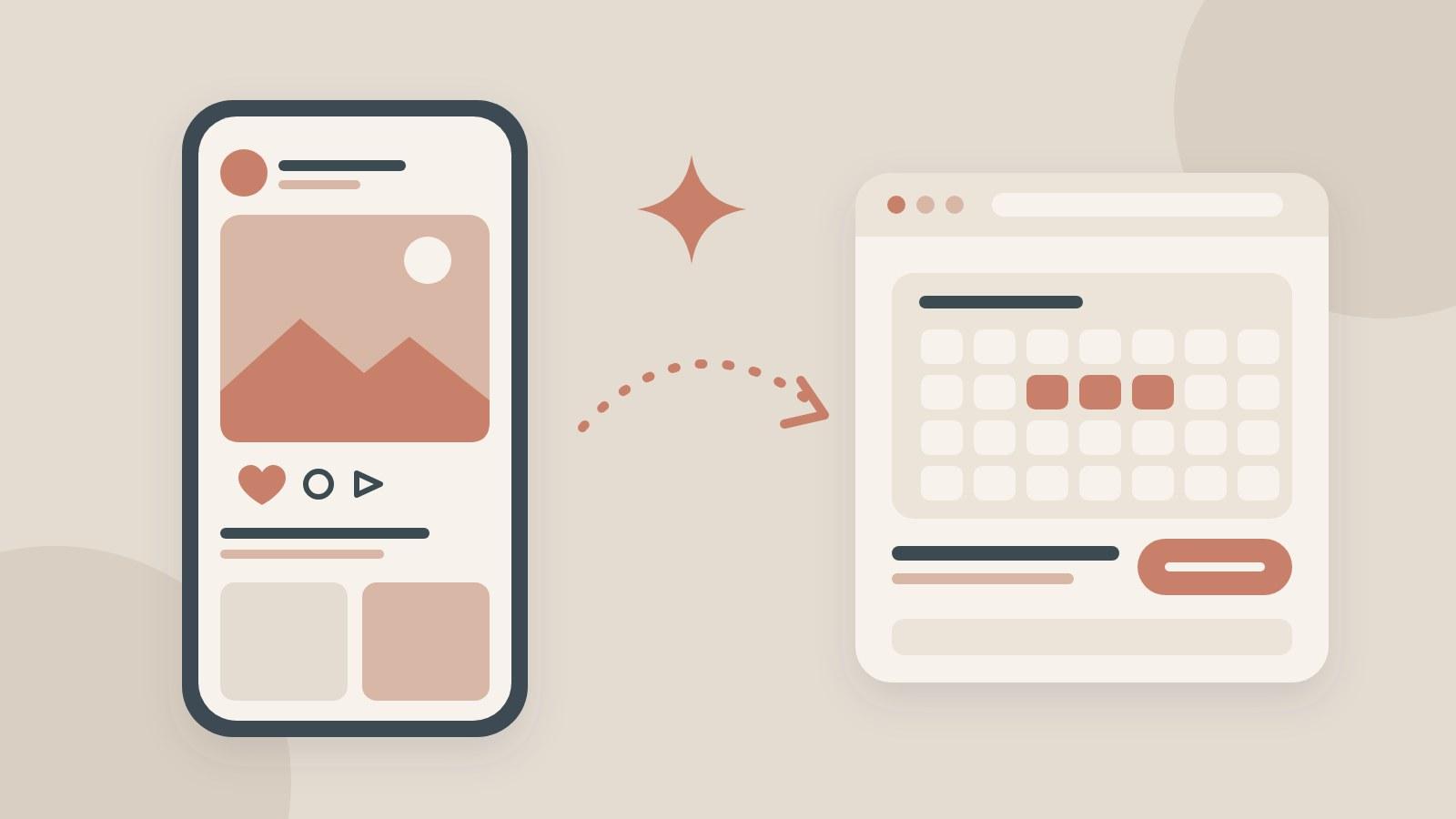
Instagram is great for being found, but you don't own it, most followers never see a given post, and guests still check a website before they pay. Here's how to make Instagram feed your site instead of replacing it.
A hotel can't rely on Instagram alone because you don't own the account, most followers never see a given post, and guests still want a website to check details and book safely. Instagram is a good place to be discovered. Your website is the place where a curious follower turns into a paid booking.
Some small hotels and guesthouses skip the website and send everyone to a DM or a WhatsApp number. It feels cheaper and faster. Here's why that's risky, and how to set up the two so they work together.
Key takeaways
- Social is where guests find you: in a 2025 Amadeus study, social media passed friends and family as the top source of US travel inspiration.
- Your website is where they decide: 39% of people across 18 markets check the hotel's own website before booking (YouGov, 2023).
- You rent Instagram: accounts can be suspended by mistake, and getting them back can take months.
- Use Instagram as the funnel, the website as the till: every post should give people a reason to visit the site.
Is Instagram enough for a small hotel?
For being seen, it helps a lot. For taking bookings, it isn't built for the job.
In a study by Amadeus (a travel technology company) of more than 2,000 US travelers, published September 2025, social media overtook recommendations from friends and family as the most influential source of travel inspiration. 34% said they use Instagram, TikTok and Facebook to discover hotels, restaurants and local experiences.
So yes, be on Instagram. But look at what happens after the inspiration. A guest who likes your terrace photo now wants prices, dates, the room size, the cancellation policy and a safe way to pay. Instagram has none of that in a form they can compare. A DM conversation can answer it, but only during your working hours and only one guest at a time.
Where do guests check a hotel before they book?
Mostly on review sites and on your own website. In a YouGov survey across 18 markets (February 2023), 57% of people said they read written reviews before booking a hotel, 44% asked friends or family, and 39% checked the brand's own website.
If you don't have a website, those guests go looking and find your Booking.com listing instead. Then they book there.
That matters because the OTA channel is big and expensive. The HOTREC Distribution Study 2024 found that OTAs handled roughly 30% of hotel overnights in Europe in 2023, while bookings through hotels' own website booking engines were 12.3% (up from 7.4% in 2013). Every booking that moves from the first group to the second keeps the commission in your pocket. We worked through that math in how to save on booking commissions.
Guests are open to booking direct. In TakeUp's 2025 survey of 350 travelers who regularly stay at independent properties, 66% said they prefer to book direct, while 57% discover properties through OTAs. (TakeUp sells revenue software for hotels.) A website is how you meet them halfway.
What happens if your Instagram account gets suspended?
You lose the account, the followers and often the messages, and there's little you can do quickly. This is the "rented land" problem.
In June 2025, TechCrunch reported a wave of complaints from Instagram users whose accounts were banned, many blaming automated moderation, while Meta gave no on-record comment at the time. By October 2026, RNZ reported that a petition against wrongful Meta bans had nearly 67,000 signatures, and that Meta's Oversight Board had found "systematic unfairness" in how accounts are disabled.
The RNZ story included a wedding photographer locked out of his business accounts from May. By his own estimate he missed more than NZ$6,000 in bookings (about US$3,300 at the November 26, 2026 exchange rate). Meta later said it had reactivated the accounts in that story. For a hotel, weeks without the account in high season would hurt.
Your domain and your website don't disappear because an algorithm flagged a post. Neither does a guest email list you collect through your own booking form. If the account goes, you can still reach the people who've stayed with you. Our post on turning guest emails into repeat revenue covers how to build that list.
How many followers actually see your posts?
Fewer than you'd think, and even fewer react. Socialinsider, a social analytics company, studied 67.5 million posts from about 579,000 brand accounts. The average engagement rate (likes and comments divided by followers) was 0.48% in 2025, and 0.45% in the third quarter of 2026. Carousels did a little better at 0.55% in 2025.
That's about one interaction for every 200 followers. Engagement isn't the same as reach, and these are brand accounts in general, not hotels. Still, the point holds: a follower count is not an audience you can count on.
A website works differently. A guest who searches "boutique hotel in Kotor with sea view" or asks ChatGPT for one can land on your rooms page any day of the year, whether or not you posted that week. We explain how AI tools pick hotels in how to get your hotel recommended by ChatGPT.
What can a website do that Instagram can't?
For the booking part of the trip, quite a lot:
- Show real prices and availability with a booking engine, so guests can book at 11 pm without waiting for a reply.
- Answer the same questions once: rooms, beds, parking, breakfast, check-in times, cancellation, how to get there from the airport.
- Rank in Google and get read by AI assistants. Instagram posts rarely show up for "hotel near the old town".
- Take payment securely, which builds trust. A guest asked to send a bank transfer by DM may stop there.
- Collect guest emails you own, for offers and return visits.
- Show your story the way you want, without a feed that pushes you down after a day.
None of this means you should post less. It means each post should point somewhere useful.
How do you turn Instagram followers into direct bookings?
Treat Instagram as the shop window and your website as the front desk. A few habits make the link work:
- Put your booking page in your bio link, not just the homepage. If you use a link page, the first button should be "Check availability".
- Match what people saw. If a Reel shows the terrace room, the link in the caption or Story should open that room, with the same photos.
- Give a reason to click. A direct-only perk (late checkout, a welcome drink, free cancellation up to a set date) gives followers a reason to book on your site instead of searching for you on an OTA.
- Answer DMs with a link. Reply warmly, then send the exact room or offer page. The guest can book while you sleep.
- Check it on a phone. Instagram is a phone app, so almost everyone who taps your link is on a phone. Tap through from the post to the booking confirmation yourself.
Your homepage has to do the rest in a few seconds. Our breakdown of hotel homepage design shows what guests look for first, and converting lookers into bookers covers the next steps.
What's one thing to do this week?
Open your Instagram profile on your phone, tap the bio link and try to book a room. Count the taps. If you land on a homepage with no booking button, or on a link that needs you to message someone, fix that first. Then make your next three posts each point to one specific room or offer on your site.
If you don't have a site that can take bookings yet, or the one you have doesn't work on a phone, book a call. Our Website Redesign package starts from $499.
FAQ
Can a hotel take bookings through Instagram DMs instead of a website?
It can, but it limits you. Every booking needs a back-and-forth conversation, guests can't compare rooms or prices on their own, and payment by transfer can feel unsafe. If the account is suspended, those conversations and leads can disappear too. A website handles this without you.
Should a small hotel spend more time on Instagram or on its website?
Set up the website properly first, then post on Instagram regularly and link back to it. The website keeps working when you're busy; Instagram needs a steady flow of posts. Once the site is solid, most of your weekly marketing time can go to social.
Do Instagram posts help a hotel's Google ranking?
Not directly in any way Google has confirmed. Instagram posts rarely appear for searches like "hotel in Budva with parking". What helps is your own website content, your Google Business Profile and reviews. Instagram can still send people who then search for your name.
What should a hotel's Instagram bio link go to?
Send it to a page where guests can check availability, or a short link page whose first button is "Check availability". Below that, add your current offer and your location page. Avoid sending people to a homepage where the booking button is hard to find.
Sources
- Hotel Dive, "Generative AI tools not yet ready for 'prime time' in travel", October 2, 2025 (Amadeus study, more than 2,000 US travelers, released September 22, 2025).
- YouGov, global hotel booking research by Janice Fernandes, May 11, 2023 (18 markets, fieldwork February 2023).
- HOTREC, European Hotel Distribution Study 2024 (reference year 2023, 3,089 hotels).
- TakeUp, "The Voice of the Boutique Travel Guest 2025", press release July 10, 2025 (350 travelers).
- TechCrunch, "Instagram users complain of mass bans, pointing finger at AI", Sarah Perez, June 16, 2025.
- RNZ via 1News, "Businesses go to staggering lengths to unblock Meta accounts", Ke-Xin Li, October 30, 2026.
- Trading Economics, NZD/USD exchange rate 0.5482, November 26, 2026 (used to convert NZ$6,000).
- Socialinsider, "2026 Instagram Organic Engagement Benchmarks", Elena Cucu, published February 20, 2026, updated November 4, 2026 (67.5M posts, about 579,000 brand accounts).

Djaner Bekir · Founder of Art of The Code. 15+ years in destination management, now building websites for hotels and restaurants. About
Want a website that turns lookers into bookers?
Related posts
 Direct bookings8 min read
How to Write Hotel Room Descriptions That Get Booked
 Direct bookings8 min read
Restaurant Reservations: Website Widget or Booking Platform?
 Direct bookings8 min read
Albania's Tourism Boom: What Hotels Need Online Now