How to Write Hotel Room Descriptions That Get Booked
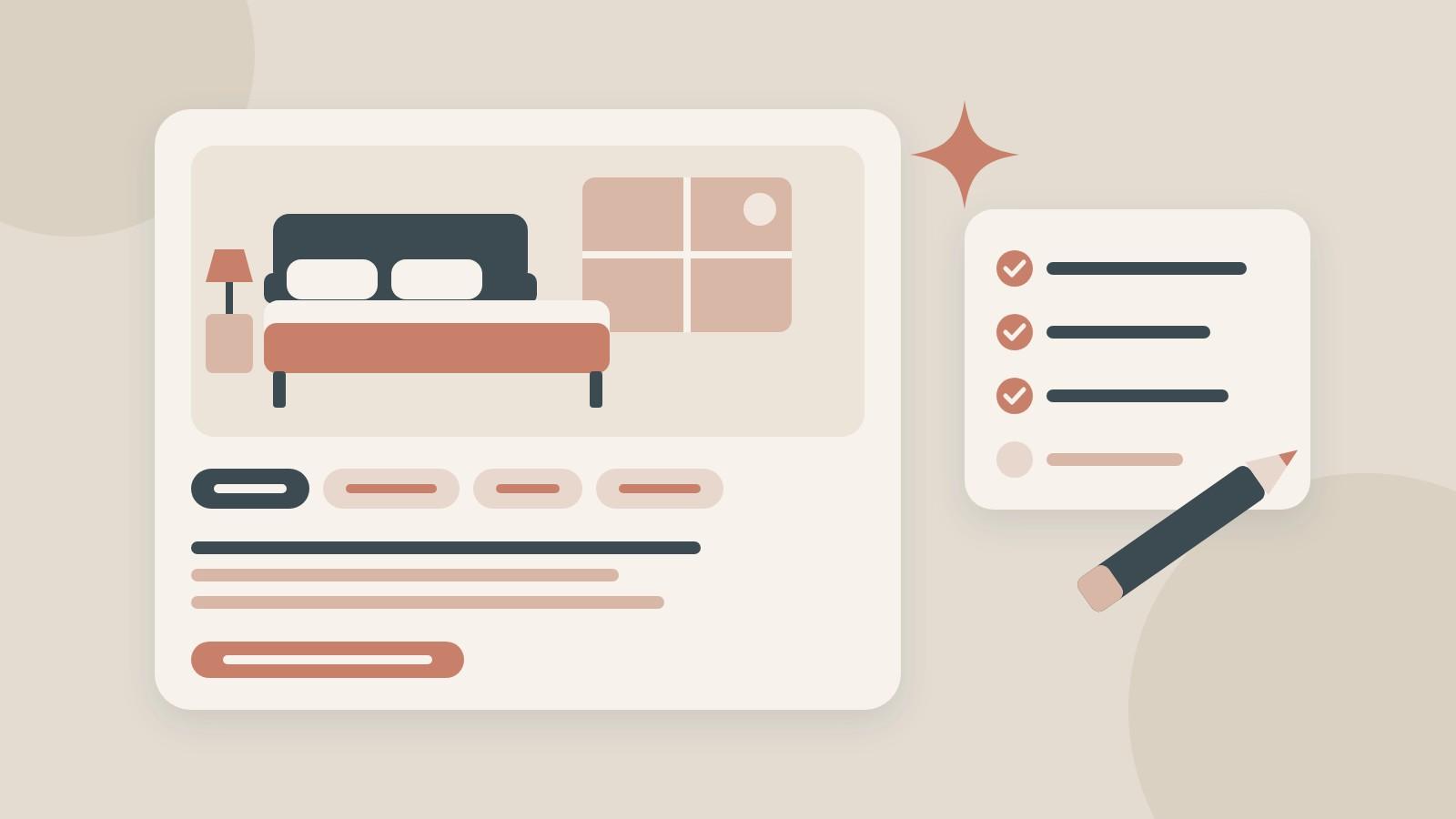
A good room description answers the guest's practical questions first, then gives them one reason to picture themselves there. Here's a simple structure, a rewrite example and three templates you can fill in today.
A room description that gets booked answers the guest's practical questions in the first line (size, beds, who it sleeps, the view) and then gives them one honest detail that helps them picture the stay. Many hotel room pages do it the other way round: a paragraph of "luxurious" and "stylish", with the bed size hidden at the bottom.
Below: a simple structure, a before-and-after rewrite and three templates for your own rooms.
Key takeaways
- Facts first: put size, bed setup, sleeps and view in one line at the top, so nobody has to hunt for them.
- Plain words win: in a 2019 US survey, travelers picked "affordable", "clean" and "comfortable" to describe a hotel they'd want; "sophisticated" and "legendary" came last.
- Words and photos must match: 62% of UK adults in a 2025 YouGov survey said they wouldn't book a place that looked dirty or outdated in photos or reviews.
- Use a structure: feeling, features, fit. Three short blocks, written once per room.
What should a hotel room description include?
Start with the details a guest uses to rule a room in or out. If these are missing, they leave to check another site, and that site is often Booking.com.
Bookassist, a hotel booking engine company, recommends that every room card shows the room name, size, maximum occupancy and bed configuration, and leads with the main features in a short header line such as "19 m² | 1 Large Double Bed | City View | Balcony" (May 2025).
So the top of each room should cover:
- Size in square meters, and square feet if you get many US guests.
- Beds: type and width, and whether twins can be joined.
- Sleeps: adults and children, and whether a cot or extra bed fits.
- View and outdoor space: sea, garden, street, courtyard, balcony, terrace.
- The one thing people complain about if they don't know: stairs with no lift, a shower over the bath, a street-facing window in summer.
That last one feels risky to write. It isn't. A guest who knew about the stairs and booked anyway won't leave a one-star review about them.
How long should a room description be?
Long enough to answer the questions, short enough to read on a phone. For most rooms that's a header line, two or three short paragraphs and a list of amenities.
Don't copy the same paragraph into every room. Write what's different: the corner room with two windows, the attic with the sloped ceiling, the family room by the garden. When the text repeats, guests pick on price alone.
Which words make guests book?
Plain ones. In Lavidge's 2019 Southwest Hospitality Marketing Report, US travelers chose from 28 words to describe a hotel they'd want to stay in. The top picks were "affordable" (66%), "clean" (58%), "comfortable" (54%), "quality" (47%) and "safe" (46%). Among the least chosen were "experiential", "sophisticated" and "legendary". The survey is old and US-only, so treat it as a direction, not a rule.
It matches what guests worry about. In TakeUp's 2025 survey of 350 travelers who regularly stay at independent properties, 38% named doubts about cleanliness or quality as a reason not to book. (TakeUp sells revenue software for hotels.)
So replace adjectives with things a guest can check:
- "Luxurious bedding" becomes "linen sheets and two pillows per guest, one firm and one soft".
- "Stunning views" becomes "you can see the old town walls from the bed".
- "Modern bathroom" becomes "walk-in rain shower, renovated in 2025".
If you can't name the specific thing, the adjective probably isn't true either.
Do room descriptions need to match the photos?
Yes, and this is where many small hotels lose trust. In a YouGov survey of 2,108 UK adults (fieldwork July 2025), 62% said they wouldn't book a property that looked dirty or outdated based on its photos or reviews, and 9% had cancelled or left a stay because the photos didn't match the property.
In a Talker Research survey of 2,000 US adults for Tennessee Tourism (reported July 1, 2026), 74% said they won't book a trip without seeing photos, and 70% had arrived somewhere that looked different from its photos.
Write each description with that room's photos open next to you. If the text says "balcony with sea view", the second or third photo should show it. If the room was renovated, say when, and make sure the photos are from after. Our hotel photography shot list covers which photos each room needs.
How do you structure a room description that converts?
Use three short blocks in this order. We call it feeling, features, fit.
- Feeling (one or two sentences). What it's like to be in the room. Light, quiet, the view in the morning. One concrete detail, not three adjectives.
- Features (a short list). Beds, size, bathroom, air conditioning, desk, coffee, Wi-Fi. The facts a guest compares.
- Fit (one sentence). Who the room suits. Couples on a short break, a family with a small child, someone working remotely for a week.
The fit line does more than it looks. It steers the wrong guest to another room and tells the right one this is theirs.
What does a before-and-after rewrite look like?
Here's an example room, written for this post. It isn't a real hotel.
Before:
Our Deluxe Room offers a luxurious and elegant stay with stunning views and modern amenities. Relax in style and enjoy a truly unforgettable experience in the heart of the city.
It says nothing a guest can check. No size, no bed, no view direction, no reason to choose it over the Superior Room.
After:
24 m² | King bed (180 cm) or two singles | Sleeps 2 | Old town view | 2nd floor, lift
Morning light comes in over the old town roofs, and the double windows keep the street quiet at night.
- Bathroom with walk-in shower, renovated in 2025
- Air conditioning and heating
- Desk by the window, fast Wi-Fi
- Coffee machine and kettle
Best for couples on a city break, or one person working remotely for a few days.
Same room. Now the guest knows what they're paying for.
Can I use templates for room descriptions?
Yes, as a starting point. Fill in the brackets with real details, then read it out loud and change anything that sounds like a brochure.
Template 1: standard double
[size] m² | [bed type and width] | Sleeps [number] | [view] | [floor, lift or stairs]
[One sentence about light, quiet or the view at a specific time of day.]
- [Bathroom: shower or bath, any recent renovation]
- [Climate: air conditioning, heating, fan]
- [Work or comfort: desk, armchair, blackout curtains]
- [Coffee, tea, minibar]
Best for [who], [what kind of trip].
Template 2: family room
[size] m² | [bed setup, e.g. one double and two singles] | Sleeps [adults] adults and [children] children | Cot on request: [yes or no]
[One sentence about space, layout or what's nearby for kids.]
- [Separate sleeping area or one open room]
- [Bathroom setup and towels for how many]
- [Fridge, kettle, anything for small children]
Best for families with [ages] who want [space, garden, beach nearby].
Template 3: room with a feature (terrace, sea view, attic)
[size] m² + [terrace size] m² terrace | [bed] | Sleeps [number] | [exact view]
[One sentence about the feature, said plainly: what you see, when the sun hits it.]
- [Outdoor furniture, shade, privacy]
- [Anything that comes with the feature: stairs, sloped ceiling, sun in the afternoon]
- [Standard amenities]
Best for [who], especially in [season].
If you have guests from several countries, translate the finished descriptions properly instead of running them through a machine. Our guide to multilingual hotel websites covers which languages pay off.
Where should room descriptions go on the website?
On your own rooms page, as real text, and again inside your booking engine. Guests read both, and they should say the same thing.
Room text on your site also helps search engines and AI assistants understand what you offer, so write it on the page, not inside an image or a PDF. We explain the wider content side in how to write hotel content that ranks.
Then check the booking step. In the TakeUp survey, 69% of independent-hotel guests said price transparency is very important. If the room page says "breakfast included" and the booking engine charges for it, the description has done its job and the checkout undoes it. Our booking engine buyer's guide lists what to look for there.
What's one thing to do this week?
Pick your best-selling room. Write a header line with size, beds, sleeps and view. Rewrite the first paragraph with one concrete detail instead of adjectives, and add a "best for" line. Then compare it with the photos and fix anything that doesn't match.
If you'd like a second pair of eyes on your rooms pages, or a site that makes them easier to read and book, book a call.
FAQ
How many words should a hotel room description be?
Most rooms need roughly 80 to 150 words: a one-line header with size, beds, sleeps and view, one or two sentences on what the room feels like, a short amenity list and a "best for" line. Write more only if the room has something unusual to explain.
Should every room have a different description?
Yes, if the rooms differ in any way guests care about, such as view, floor, size or bed setup. Copying the same paragraph across rooms makes them look identical, so guests pick on price. Write about what makes each room different.
Is it OK to mention a room's downsides?
Yes. Stairs without a lift, a small bathroom or a street-facing window are better said plainly in the description than discovered at check-in. Guests who book knowing the facts are less likely to complain or leave a poor review about them.
Should I write room descriptions with AI tools?
You can use them for a first draft, but check every detail against the real room and the photos, and cut generic adjectives. Guests notice vague text that could describe any hotel. Your own specific details are what make the room feel real.
Sources
- YouGov, "Top booking factors for UK travellers and the dealbreakers that end a stay", fieldwork 9-10 July 2025, 2,108 UK adults.
- Hotel News Resource, Talker Research survey for Tennessee Tourism, 2,000 US adults, July 1, 2026.
- TakeUp, "The Voice of the Boutique Travel Guest 2025", press release July 10, 2025, 350 travelers.
- Lavidge, "Travelers prefer hotels or resorts described in practical terms", Southwest Hospitality Marketing Report, February 4, 2019.
- Bookassist, "Booking Platform 'Room Card' Recommendations", May 20, 2025.

Djaner Bekir · Founder of Art of The Code. 15+ years in destination management, now building websites for hotels and restaurants. About
Want a website that turns lookers into bookers?
Related posts
 Direct bookings8 min read
Hotel Website vs. Instagram: Why Social Alone Falls Short
 Direct bookings8 min read
Restaurant Reservations: Website Widget or Booking Platform?
 Direct bookings8 min read
Albania's Tourism Boom: What Hotels Need Online Now