Multilingual Hotel Websites: Which Languages Pay Off?
How to pick the languages for your hotel website from your own guest data, set them up so Google shows the right one, and translate without losing trust.
A multilingual hotel website pays off when it's in the languages your guests actually read, with each language on its own URL and hreflang tags so Google shows the right version. For most small hotels on the Adriatic that means English plus one or two more, picked from your own booking data rather than a long row of flags.
Here's how to choose the languages, how to set them up so Google can find them, and the translation mistakes that cost bookings.
Key takeaways
- Pick languages from your guest data: the countries in your booking reports, not every country on the map.
- English covers a lot, not everyone. 47% of Europeans say they can speak it (Eurobarometer, 2024).
- German guests care most. In CSA Research's survey they were the most likely to buy only from sites in their own language.
- Give each language its own URL, such as /de/, and link the versions with hreflang.
- Translate the whole path to booking, including room names, policies and the booking engine.
Why does a hotel website need more than one language?
Because many guests won't book in a language they don't read well. In CSA Research's "Can't Read, Won't Buy" survey of 8,709 online shoppers in 29 countries (July 2020), 76% said they prefer buying products with information in their own language. 40% said they never buy from websites in other languages. German shoppers stood out: 57% bought only from sites in their own language, the highest share of any country surveyed.
A hotel stay is a bigger purchase than most online shopping. Guests read your cancellation policy, check what breakfast includes and compare rooms. Doing that in a second language takes longer and leaves room for doubt. Doubt sends people back to Booking.com, which already shows your property in their language.
English still does a lot of the work. The EU's 2024 "Europeans and their languages" Eurobarometer found that 47% of Europeans can speak English, up five points since 2012. That's a big group. It also means more than half of Europeans can't, or don't think they can.
Which languages should an Adriatic hotel add?
Start with your own data. Pull the guest nationality report from your property management system or channel manager for the last two seasons, and check the countries in Google Analytics. Add a language when a market brings a real share of your guests, or when you want to grow it and are ready to market to it.
National figures show the bigger picture:
- Croatia: the eVisitor system recorded 110.1 million overnight stays in 2025. Germany led with 22.3 million, ahead of domestic guests (13.8 million), Slovenia (11.1 million), Austria (8.2 million) and Poland (7.3 million). The UK came seventh with 4.1 million. For most Croatian properties, German is the first language to add after English.
- Montenegro hotels: in July 2025, Monstat counted Serbia as the top source of foreign overnight stays in collective accommodation (25.6%), followed by the UK (5.9%) and Poland (4.9%).
- Montenegro private rentals: for apartments and rooms in 2025, the top foreign markets by overnight stays were Serbia (25.6%), Russia (22.1%), Bosnia and Herzegovina (9.4%) and Turkey (4.9%). Germany had 3.9% and the UK 2.3%.
So the right mix depends on the type of stay as well as the country. A hotel in Kotor and a rental apartment ten minutes away can have very different guests.
Regional guests are a special case. Serbian, Croatian, Bosnian and Montenegrin are close enough that guests from across the region read each other's languages easily. One well-written local version usually serves all of them, so you don't need four.
Our Montenegro direct bookings guide makes the same point from another angle: know who your guests are, then build the site for them.
How many languages is too many?
Every language you add is another website to keep current. Prices change, offers expire, a new room opens. If the German page still shows last year's breakfast hours, it does more harm than having no German page at all.
A good rule for a small hotel is English plus your one or two largest non-English markets. Add the local language if you get domestic or regional guests. Go further only when someone on your team can check and update every version.
How do you set up language versions so Google finds them?
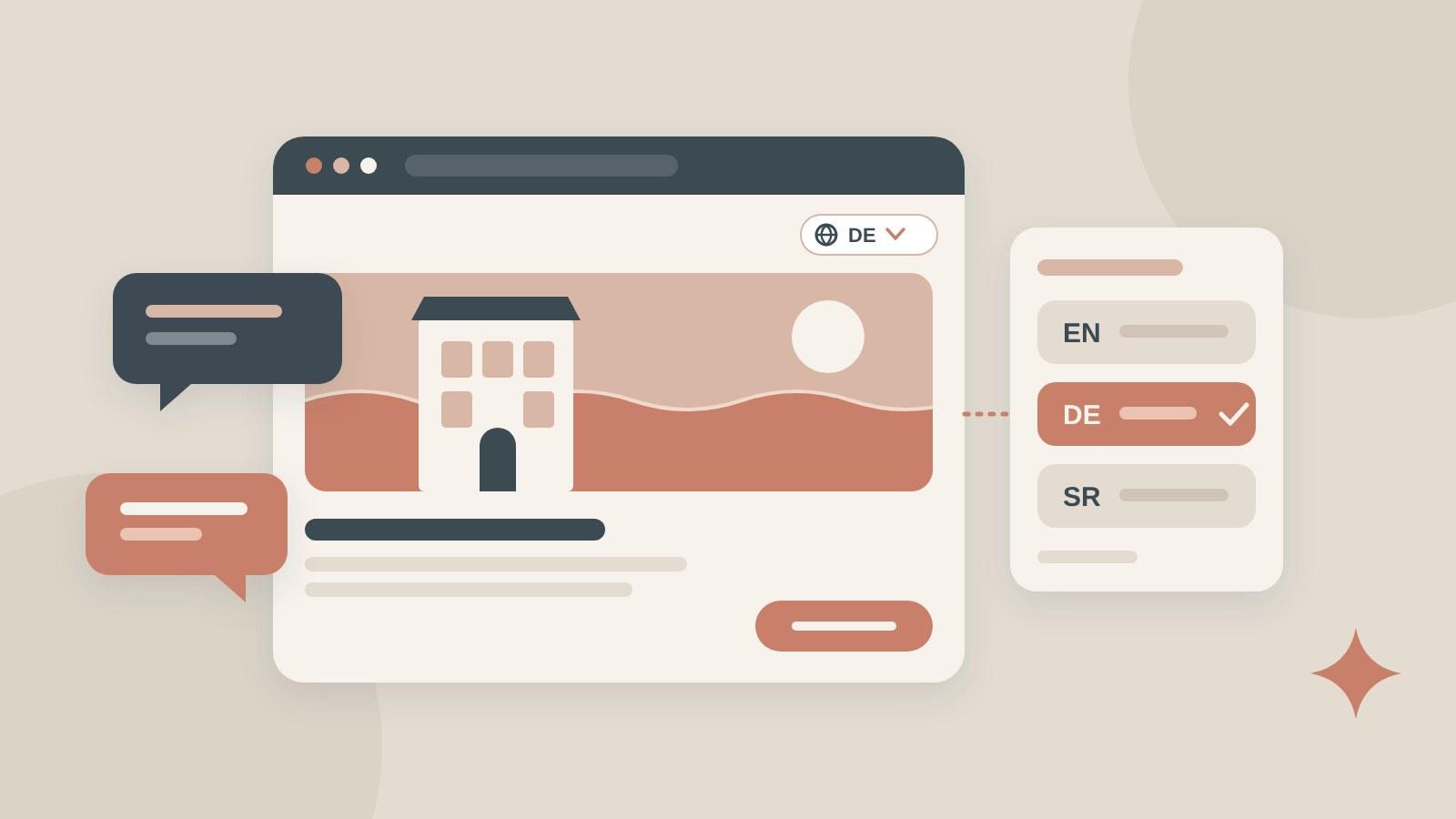
Give each language its own URL. Google recommends a separate URL for each language version. Don't switch the language with cookies or browser settings on the same address, because Google might not find all your versions. For a small hotel, subfolders are the easy choice: yourhotel.com/de/ for German, yourhotel.com/sr/ for Serbian. Google describes them as easy to set up and low maintenance, since everything stays on one domain.
Don't redirect guests automatically. Sending a visitor to the German site because their browser or location looks German can stop people, and search engines, from seeing your other versions, Google says. Put a clear language switcher in the same spot on every page instead, with each language written in its own name (Deutsch, Srpski) rather than flags.
Link the versions with hreflang. Hreflang tags tell Google which pages are translations of each other. Each page lists itself and every other version. For a rooms page in English and German, both pages carry the same three lines in their head:
<link rel="alternate" hreflang="en" href="https://yourhotel.com/rooms/" />
<link rel="alternate" hreflang="de" href="https://yourhotel.com/de/rooms/" />
<link rel="alternate" hreflang="x-default" href="https://yourhotel.com/rooms/" />
A few rules from Google's documentation:
- The links must go both ways. If two pages don't point to each other, Google ignores the tags.
- Use full URLs, including https.
- Use two-letter language codes from ISO 639-1 (en, de, sr, hr), with an optional region code after them (en-gb).
- x-default marks the fallback page for anyone whose language you don't offer.
You can add hreflang in the page head, in HTTP headers or in your sitemap. Google treats all three the same, so pick one. Google also works out a page's language from its text, not from these tags, so the page itself has to be properly translated.
Planning a website redesign? That's the moment to set the URL structure, before old pages need redirects.
Is machine translation good enough for a hotel website?
As a first draft, often yes. As the final version, no. Google's spam policies name automated translation used to churn out pages with little value for users as an example of scaled content abuse. And a clumsy translation of your room descriptions tells a German guest you didn't make the effort, right when you're asking them to trust you with a booking.
The sensible middle path is to draft with a translation tool, then have a native speaker read every page. Ask them to check:
- Room names and bed types (a "double room" with two singles confuses everyone)
- Cancellation, deposit and check-in policies, word for word
- Prices, dates and number formats (Germans write 1.200,00 €)
- The local words guests search for, like Ferienwohnung for a holiday apartment
That last point is about search. People type their own words into Google, so your German page should use the phrases German guests use. Our post on long-tail keywords for niche travelers shows how to find them.
What else needs translating besides the pages?
The parts guests touch on the way to booking:
- The booking engine. If the site is in German but checkout jumps to English, you lose the trust you just built. Check that your booking engine supports your languages and that the choice carries over from your site. It's on the list in our booking engine buyer's guide.
- Confirmation and pre-arrival emails, in the language the guest booked in.
- Page titles and meta descriptions, since that's what guests see in Google results.
- Structured data, so the hotel details on each version match its text. Our hotel schema markup guide has examples.
- Photo alt text, for accessibility and image search.
Frequently asked questions
Can I use a translate widget instead of translated pages?
A widget that translates on the fly doesn't give each language its own URL, so search engines can't index those versions and guests searching in German won't find you. It helps visitors who already arrived, but separate translated pages with hreflang do far more for bookings.
Do I need a separate domain for each language?
No. Country domains like .de give the clearest signal for one country, but they cost more and need more upkeep. For a small hotel, subfolders such as /de/ on your main domain are easier to set up and maintain, and Google supports them fully.
Which language should be my default?
Usually English, as the language most international guests can read. Set it as x-default in your hreflang tags so anyone whose language you don't offer lands on the English version. If most of your guests are regional, the local language can be the default instead.
The bottom line
Your one action today: pull your guest nationality report for the last two seasons and rank the countries. Then count how many of your top five markets you can serve in their own language right now. That gap is your list for the next version of the site.
Want a multilingual site that's easy to keep current? Book a call and ask for a free look at your site.
Sources
- CSA Research, "Survey of 8,709 Consumers in 29 Countries Finds that 76% Prefer Purchasing Products with Information in their Own Language" (July 7, 2020)
- European Commission, "Europeans strive toward multilingualism and value language diversity, according to latest Eurobarometer" (May 21, 2024)
- Croatia Week, "Croatia tourism 2025: record 110 million overnight stays" (January 7, 2026)
- Monstat, "Tourist arrivals and overnight stays in collective accommodation, July 2025" (October 29, 2025)
- Monstat, "Arrivals and overnight stays in individual accommodation, 2025" (March 5, 2026)
- Google Search Central, "Managing multi-regional and multilingual sites" (last updated December 10, 2025)
- Google Search Central, "Tell Google about localized versions of your page" (last updated September 21, 2026)
- Google Search Central, "Spam policies for Google web search" (last updated August 28, 2026)

Djaner Bekir · Founder of Art of The Code. 15+ years in destination management, now building websites for hotels and restaurants. About
Want a website that turns lookers into bookers?