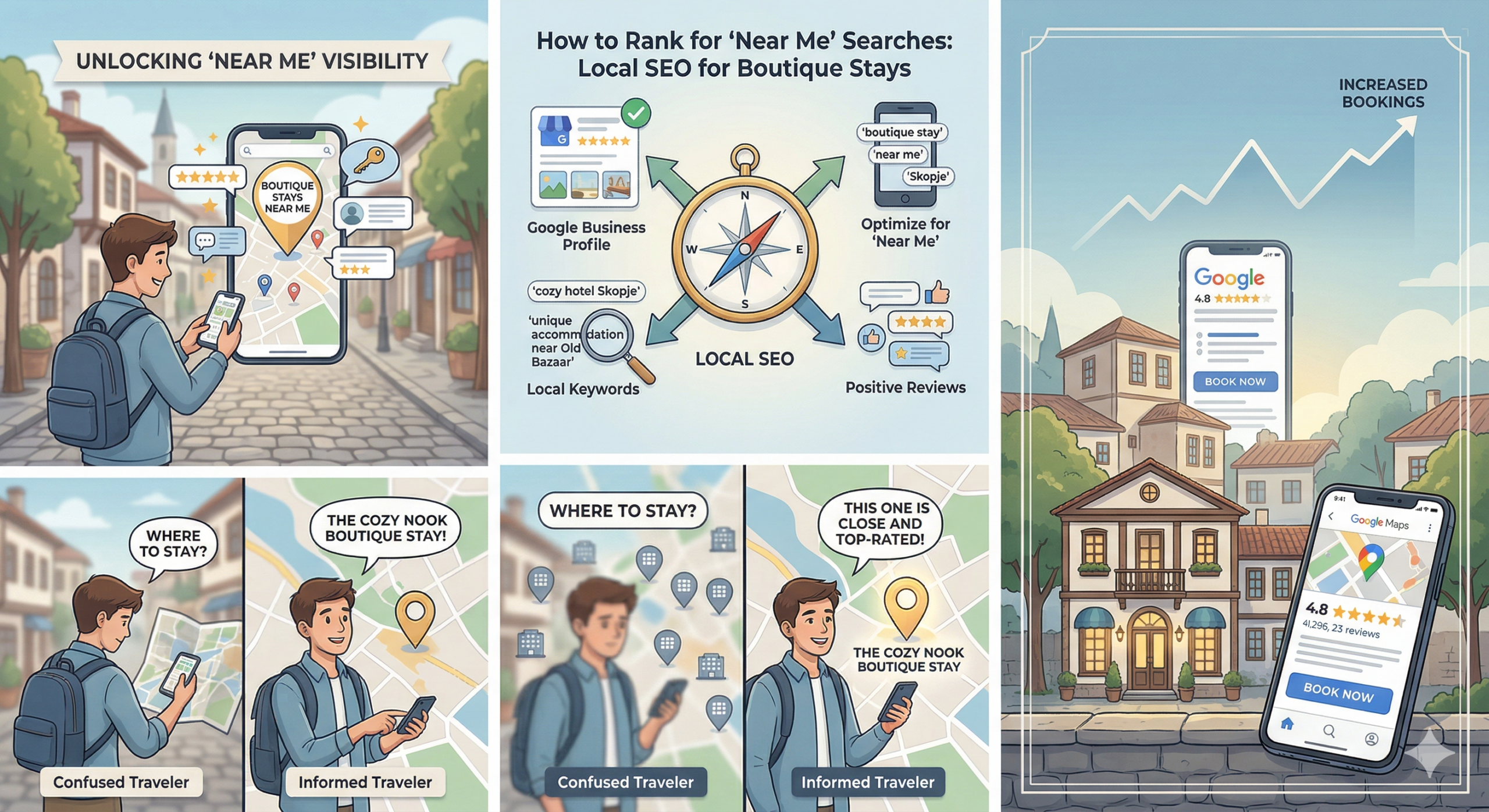
Guests search for a cozy place nearby. You can show up when they type ‘near me’ if you follow clear local SEO steps. This article covers practical tactics for boutique stays and explains what to do and why it matters.
Why ‘near me’ searches matter for boutique stays
Mobile searches with the phrase ‘near me’ often come from people ready to book or visit. This means higher intent and a better chance to convert a search into a stay. Showing up locally matters more than broad national rankings for small properties.
Search engines want to connect a local user with the closest, best match. They use signals from maps, business listings, website pages, and reviews. These signals favor businesses that present clear and consistent local information.
For boutique stays, a local presence builds trust. Many travelers prefer unique, nearby options over chain hotels. If your listing and site explain what makes your property special, you can attract guests who value design, service, and a local vibe.
Optimize your Google Business Profile
Your Google Business Profile is often the first thing a potential guest sees. Use it to show accurate hours, photos, and amenities. Keep information current and complete to help search engines and guests trust your listing.
Before you edit, collect exact business details. That includes your official name, street address, phone number, and a short description. Consistency matters across all platforms.
Use this checklist to complete and strengthen your profile. Fill each item carefully and use concise, friendly language.
- Complete business name and categories that match your boutique stay style.
- Accurate address and a precise service area if you offer pickup or shuttle service.
- Phone number that connects directly to bookings or front desk staff.
- Clear opening hours and seasonal notes where relevant.
- High-quality photos of rooms, common areas, and the neighborhood.
- A complete amenities list such as free wifi, breakfast, or pet policy.
After completing the profile, verify it with Google. Verification unlocks features like messaging and posts. It also helps your listing appear more prominently in local map results.
Keep editing your profile. Add new photos monthly and post updates about specials or events. Fresh content signals activity to search engines and encourages clicks from travelers.
On-page local SEO for boutique websites
Your website must clearly show where you are and what you offer. Use simple pages for rooms, rates, and local attractions. Include your address in visible places like the header or footer for easy scanning.
Use local keywords naturally. Phrases like ’boutique stay near [neighborhood]’ or ‘small hotel near [landmark]’ help search engines match local queries. Avoid keyword stuffing. Keep language natural and helpful for readers.
Below are practical on-page items to focus on. These steps help search engines understand your site and help guests find what they need fast.
- Title tags and meta descriptions with location terms and a clear offer.
- Header tags that include room types and local points of interest.
- Schema markup for local business and lodging to provide structured data.
- Visible NAP information (name, address, phone) in plain text on every page.
- Dedicated landing pages for neighborhoods and nearby attractions.
Implement schema for lodging to improve how search engines present your listing. Basic markup can show ratings, address, and availability. This helps with click-through rates from local search results.
Keep page load times low. Fast pages help rankings and reduce bounce. Optimize images and limit heavy scripts. A smooth site experience helps both search engines and guests.
Local content and keyword strategy
Content that ties your property to local experiences helps you rank for nearby searches. Write short guides about the neighborhood. Mention landmarks, transit stops, and local cafes that guests love.
Start by mapping useful keywords. Include terms guests use when searching for stays near a spot. Aim for phrases that include a location and intent, such as ‘places to stay near [park]’ or ’boutique room near [station]’.
Here are easy content ideas to attract local searchers. Each idea connects your boutique to nearby interests and helps search engines match queries.
- Short neighborhood guides with suggested morning, afternoon, and evening plans.
- Lists of nearby restaurants and cafes with reasons guests like them.
- Local events and seasonal activities that draw visitors to your area.
- Guest stories or testimonials that mention nearby places and experiences.
- Practical guides for arrival, such as nearest transit stops or parking tips.
Publish content regularly but keep it focused and useful. Regular updates tell search engines your site is active. It also gives travelers fresh reasons to choose your stay.
Use internal links to connect local pages with room pages and booking calls to action. This helps users move from discovery to booking in a few clicks.
Local citations, reviews and reputation
Consistent citations help search engines confirm your location and contact details. Citations are entries of your business on directories and local sites. Make sure the information matches your official details exactly.
Guest reviews are one of the strongest signals for local search. Encourage happy guests to leave reviews after their stay. Respond to reviews professionally and promptly.
Consider these citation and review practices to build trust and visibility. They are simple steps that can have a big impact over time.
- List your business on reliable local directories with the same NAP details.
- Create or claim listings on travel and hospitality platforms, then keep them updated.
- Ask for reviews via email after checkout and include a friendly request on receipts.
- Respond to both positive and negative reviews with calm, helpful messages.
- Track your reviews and mentions to spot trends and address issues fast.
Monitor listings for duplicates and remove or correct them. Duplicate entries can confuse search engines and dilute ranking signals. Regular cleanup keeps your local presence strong.
Positive reviews and a consistent citation profile make local search algorithms more likely to rank your property in ‘near me’ queries. They also create social proof that helps convert interest into bookings.
Technical and mobile experience
Most ‘near me’ queries start on phones. Mobile experience is a ranking factor and a conversion factor. A fast, readable mobile site leads to more bookings and better local search performance.
Check these technical areas to make sure your site performs well for local searchers. Small fixes can improve speed and usability quickly.
Use this list as a technical checklist. Each item helps search engines and users interact with your site in a helpful way.
- Mobile-friendly layout with large tap targets for booking buttons.
- Fast load times by compressing images and using browser caching.
- Clear booking flow with minimal clicks and visible contact options.
- Structured data for local business and breadcrumb markup for navigation.
- Secure site with HTTPS and no mixed content issues.
Run simple tests like mobile speed and usability checks. Fix glaring issues first, then tune performance. Even small improvements can raise your visibility in local results.
Ensure your booking system shows local availability and allows quick contact. Many guests will call or message if they want a quick answer. Make it simple for them to reach you.
Measuring success and tools
Track what matters for local SEO: local rankings, clicks from map results, calls from listings, and booking conversions. Measure regularly to see what works and what needs change. Simple tracking provides clear signals for improvement.
Set up basic tools to monitor performance. Use them to compare traffic sources and to spot which local pages drive bookings. Adjust your strategy based on real data rather than guesswork.
Here are practical tools and metrics to watch. Each item helps you measure and improve local visibility over time.
- Google Business Profile insights for searches, views, and actions.
- Analytics for organic traffic to local landing pages and booking conversions.
- Rank tracking for local keywords and map pack visibility.
- Review monitoring tools to collect and respond to guest feedback.
- Site speed and mobile usability reports to keep performance high.
Review these metrics regularly and set simple goals, such as improving map views or increasing calls from the listing. Small, measurable wins add up to steady growth.
Use reports to guide content updates and profile edits. If a local page performs poorly, test new headlines or add nearby attractions to increase relevance.
Key Takeaways
Ranking for ‘near me’ searches is a mix of strong local listings, helpful website content, and a fast mobile experience. Work on each area and keep details consistent across platforms. Small fixes make a big difference.
Focus on clear NAP information, a complete Google Business Profile, and local content that matches guest intent. Encourage and respond to reviews and keep your site fast and mobile friendly.
Measure results and adjust the approach. Use simple tools to track local visibility and bookings. Repeat what works and refine what does not. Your boutique stay can become the local choice for travelers who search ‘near me’.
Current website: Artofthecode. Use these steps to improve your local reach and welcome more nearby guests to your property.